|

|

|
 |
 |

Commercial License Purchasing Plan

The commercial fishing license purchasing plan of the Saltwater Conservation Association of Texas is our first major undertaking in fulfilling our mission of maintaining and improving the health, diversity, and productivity of the coastal waters of the State of Texas. In fact, it was the purchase and retirement of commercial shrimping licenses for which SCA Texas was initially formed. SCA Texas decided that the purchase and retirement of commercial fishing licenses from the waters of the State of Texas is its foremost priority in that this project will have immediate far-reaching positive results. Additionally, there are guidelines for successfully conducting this type of project from within the Texas Parks and Wildlife’s own commercial license retirement project.
How did this get started?
During his tenure as the governor of our great state, President George W. Bush signed into law Senate Bill 750, House Bill 2542, and Senate Bill 1303. These three laws allowed the Texas Parks and Wildlife Commission to establish license limitation programs for commercial shrimping, crabbing, and finfish fisheries to improve the economic stability of the fisheries while providing long-term conservation for shrimp, crab, and finfish stocks. In its most basic form, the laws allowed TP&W to limit the number of licenses issued to these commercial fisheries. Furthermore, after these licenses were issued, no more licenses would be sold, period. After that, TP&W began to buy these licenses and retire them from service. After an initial grant from the federal government of 1.4 million dollars, additional funding for this project was generated through an increase in the price of the saltwater stamp by three dollars. This increase generates approximately 1.4 million dollars annually for the buy-back program, but the increase will expire after a five-year period.
Members of the Board of Directors of SCA Texas met with officials from TP&W to discuss the procedures that TP&W uses with its buy-back program and if there was a need for a private effort, such as ours, to help facilitate the buy-back project. Their answer, a resounding “Yes!” Everyone we have contacted at TP&W is genuinely excited by our involvement and shown great support in terms of procedural guidance and indirect participation.
How do these projects work, exactly?
SCA Texas, working with the commercial fishing license owner’s list, solicits bids to purchase the licenses. The law specifies specifically that any one person may only purchase two shrimping licenses per year from another individual. However, SCA Texas petitioned Texas Parks and Wildlife to have one of its members named as an official agent of TP&W so that we may purchase as many licenses as possible, provided that they are handed over to TP&W for retirement. Of the bids that come in, SCA Texas will choose a specified number of licenses that fall within a range of what TP&W determines as far market value of those licenses. SCA Texas will work directly with TP&W to keep the market value of those licenses from skyrocketing due to speculation by unscrupulous individuals. At such a time that bids activity starts to wane or TP&W no longer participates, SCA Texas will directly solicit licenses from the commercial anglers. As an incentive, SCA Texas is prepared to purchase the vessels and gear from the individuals in order to obtain and retire the licenses.
Which of the license types are being sought first?
SCA Texas wishes to pursue the purchase and retirement of bay shrimping licenses over crabbing and finfish licenses at this time. We feel the impact of reducing the number of bay shrimpers will be immediate and far-reaching. Furthermore, the reduction of by-catch of blue crab and stone crab by shrimpers may help to recover the over-fished crab industry, to a degree. However, after the bay shrimping license purchase program has matured, we will work to reduce all other commercial fishing in our waters
What do the numbers say?
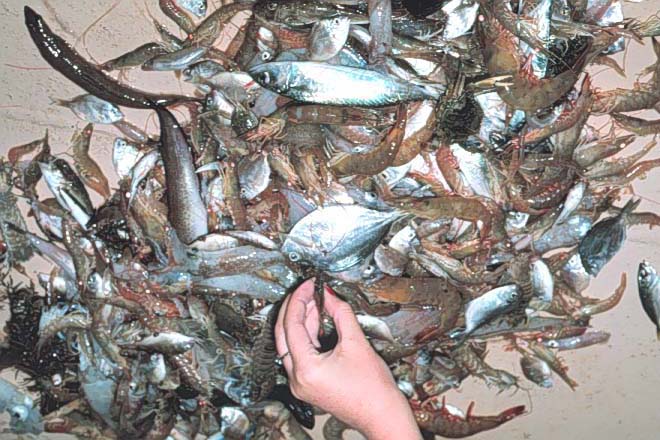
What kind of impact do shrimpers have on our bays? It’s simple numbers. Using industry-independent data, a shrimper catches between 3.5 to 5 pounds of fish, crabs, and everything else that isn’t fast enough to get out of the way for every pound of shrimp they take home. Much of this by-catch is important food sources for trout and reds. Look at it this way, if for every limit of trout, red, or flounder you keep, you simply chopped the heads off of 35 to 50 trout, 11 to 15 reds, and 35 to 50 flounder and threw them away, what kind of shape would our bays be in? Better yet, if for every $6 you earn, you burned $5 of it. How good of shape would you be in financially? By-catch mortality has even been cited as being an important factor in the decline of our flounder stocks.
The commercial industry contends that much of the by-catch is returned alive to the waters from where it came. However, there are a couple of questions that bother us. For example, just how long does your personal bait live if you drop it on your hot boat deck in July or August? A few minutes at the most? Is that long enough to sort-out a couple of pounds of shrimp from the debris and get it to ice? So what kind of condition is the by-catch in when it is returned to the water? If you’re a shrimper, do you worry about getting those dying animals off of your deck and back into the water so they’ll have a chance at living? Or do you get your shrimp sorted and on ice, your nets back into the water, and then wash back into the water whatever hasn’t crawled off? A few questions that’s all.
Texas Parks and Wildlife reports that approximately 80 million pounds of by-catch will be brought on board the shrimping vessels in the bays of Texas this year. However, all shrimp caught in Texas will be worth about one-half billion dollars. This one-half billion is achieved, in part, by a 300 percent increase in bay shrimping activity since the 1970’s. During the same time period, the bay shrimp harvest has climbed 400 percent while the number of shrimp caught per hour has been cut in half. Worse still, there has been a 30 percent decrease in the number of adult spawning shrimp in the Gulf, which means there are less shrimp being hatched every year to replenish the ones caught the year before. End result, the shrimping industry, and our bays, collapse. Is that five hundred million-dollar industry worth seeing our bay and Gulf fishing go down the toilet? Absolutely not, especially when you consider that saltwater anglers generate four times what the shrimping industry does. $2,000,000,000; that is the hard dollar amount of what you and I spend in this state on fishing every year. So who should have the louder voice when it comes to managing our public marine resources? You and I, the recreational saltwater angler, that’s who. SCA Texas is going to make sure our voices are heard loud and clear. You’ve made your investment in fishing, now make your investment in the fish.
Home | Conservation |
About SCA | Membership | Contact SCA